|
|
 Our solarsystem

Mercury Venus Earth Moon Mars Jupiter Saturn Uranus Neptune Pluto
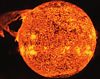
The sun
The sun, a huge ball of gas at about 149,600,000 km ( =
1 AU ) from earth.
The sun's radius is 696,000 km; volume = 1,412 x 10 18 km³ ; mass 1,99 x 10³°
kg (330,000 times the eatrh's mass) ; 1,41 g/cm³; surface tempurature about
6000° K.
The sun is at about 32,000 lightyears from the center of the Milkyway and moves
in the Milkyway at a speed of 250km/s. The seemingly daily movement of the sun
is a reflection of the rotation of the earth.
The seemingly diameter of the solardisc varies because the distance between the
sun and the earth isn't always the same; The seemingly diameter varies in the
year between 31,32² and 32,36². The total radiationcapacity of the sun is
about 4 x 1026,W , of which the 2 billionsth part is caught by the earth.
In the first estimation people devide the solar body in 3 parts: the visible
(with the eye) part of the sun: the fotosphere, around that the cromosphere: a
pretty thin, hardly visible peel and around that the thin corona. Often people
see dark solarspots on the solar disc of which number, sizes and lifetime
strongly vary.
The number of solar spots is a period of about 11 years.
High above the cromosphere sometimes people see (during a solar eclipse) purple
red protuberae (= solarflames). An average length of a protuberae is hundreds of
thousends of kilometers and 10,000 km thick.
In the corona, that step by step changes into the gas of the interplanetary
mater, the temperature goes up to over a million degrees.
The attractive power of the sun is pretty small there that about 1011kg of mater
per second flows into space.
The energy production of the sun (4 x 10 ²4 J/s) rest with, just like the other
stars, the nucliar fusion in the center of the sun.